Press Release
CBRE Survey: We're Heading Toward an Era of Adaptive Offices
October 2, 2025
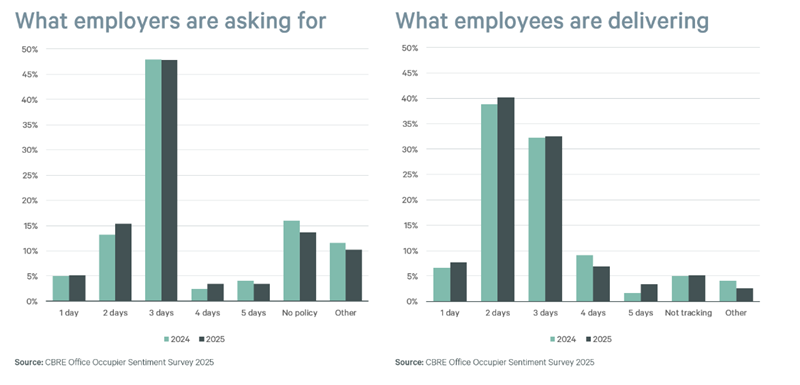
The latest survey by CBRE, a global leader in commercial real estate services, reveals a persistent gap between employer expectations and the reality of employee office attendance. While 54% of companies require office presence at least 3 days per week, only 42% of companies actually achieve this target. The survey, which included 117 European companies including firms operating in the Czech Republic, maps current trends in office space and company strategies for creating a more attractive work environment.
Companies Seek Ways to Increase Employee Workplace Presence
Results of a Europe-wide survey reveal a fundamental shift in the approach to hybrid work. A total of 47% of companies plan to actively work on increasing office attendance, while last year only 31% had such plans. The most significant gap between requirements and reality is shown in the financial services sector, where 61% of firms require attendance 3 or more days per week, but only 32% of employees actually achieve this frequency. However, instead of mandates and directives, companies are planning positive motivation. They want to attract employees through a more appealing work environment and better office atmosphere.
"For more than half of companies (53%), the biggest challenge today is how to create a dynamic and inspiring work environment. We're encountering a paradox – people don't want to come to half-empty offices, but it's precisely their absence that creates the emptiness they're avoiding. This vicious circle is most visible especially on Mondays and Fridays," describes Simon Orr, Head of Tenant Representation, Office Leasing at CBRE Czech Republic.
Average weekly office space utilization is at 46%, while reaching 71% during peak attendance days. An interesting shift was recorded in the technology, media, and telecommunications sector, where space utilization on the busiest days increased from 61% to 69%, which is related to many large technology giants tightening their work-from-home policies.
Flexible Spaces as the Solution of the Future
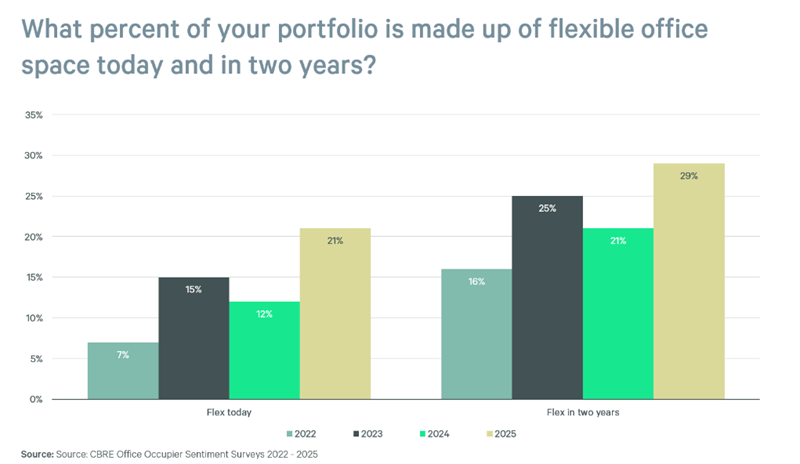
A significant trend is the growing appetite for flexible office solutions. Companies are aiming for flexible spaces to comprise 29% of their portfolio by 2027, representing an 8% increase from the current level. The main reason is the effort to avoid high initial investments in equipment and space modifications (64%) and the ability to operationally adjust office capacity according to current needs, which is difficult to estimate in the era of hybrid work (43%).
"Companies are transitioning to more flexible arrangements where more employees share fewer workstations. The traditional 'one person per desk' model is rapidly disappearing. A Europe-wide survey suggests that the share of companies with this arrangement will drop from today's 53% to 28% over the next two years," says Helena Hemrová, Head of Office Leasing at CBRE Czech Republic, and continues: "Companies are also much more closely monitoring the return on their office investments. 88% of them (versus 60% last year) already measure the effectiveness of their workspace in some way, primarily in terms of occupancy, employee satisfaction, operating costs, and environmental impact."
Portfolio Changes and Concerns About Future Supply
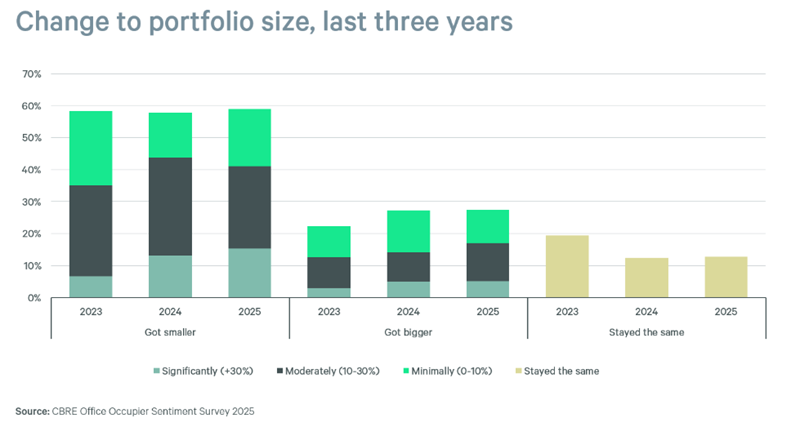
After a period of dramatic changes, the office market is entering a stabilization phase. While nearly six out of ten companies have reduced their space in the last three years, this trend is slowing – the share of companies planning reductions has decreased from 60% to 55%. The main reasons remain the expansion of hybrid work (70%) and pressure for savings (56%). However, radical cuts exceeding 30% of space, previously implemented by 15% of companies, are planned by almost no one for the future. Conversely, around a quarter of companies are expanding their offices, signaling a gradual market calming and transition from hasty steps to thoughtful optimization. The share of expanding companies that previously underestimated the actual workspace requirements of their teams and whose reductions proved premature has increased from last year's 7% to the current 21%.
Companies planning to relocate to new premises, however, express growing concern about limited supply. A full 52% of them fear they won't find offices meeting their quality and location requirements. The priorities are clear: essential is public transport accessibility (required by 94% of companies) and an attractive location with developed service infrastructure and civic amenities (80%).
Sustainability and Building Quality as an Ever-Growing Priority
However, companies expect much more from modern offices: environmental sustainability, comprehensive services available directly in the building, and the ability to flexibly adapt spaces to current needs. Financial institutions are particularly uncompromising in these requirements: for 82% of them, the building's environmental profile is crucial, and all without exception require location within reach of public transport.
"Current office requirements are clear – they must be sustainable, cost-effective, and last but not least, attractive to the people that the respective company considers indispensable. We're heading toward an era of adaptive offices that can flexibly respond to the changing needs of organizations and their employees," concludes Simon Orr.
About the Survey
The CBRE European Office Occupier Sentiment Survey 2025 included 117 companies across Europe. Respondents represented various sectors including financial services, technology, media and telecommunications, energy, and industry.
CBRE Group, Inc. (NYSE: CBRE), a Fortune 500 and S&P 500 company headquartered in Dallas, is the world’s largest commercial real estate services and investment firm and a premier provider of critical infrastructure services (based on 2025 revenue). The company has more than 155,000 employees (including Turner & Townsend employees) serving clients in more than 100 countries. CBRE serves clients through four business segments: Advisory (leasing, sales, debt origination, mortgage servicing, valuations); Building Operations & Experience (facilities management, property management, flex space & experience, data center solutions); Project Management (program management, project management, cost consulting); Real Estate Investments (investment management, development). Please visit our website at www.cbre.com.